




In water quality monitoring, water conductivity sensors act as "water quality detectives", capturing ion changes to reflect water purity and pollution levels. Widely used in laboratory analysis, industrial quality control and environmental monitoring, water conductivity sensors are indispensable. ERUN is a professional manufacturer specializing in the production of ERUN-A4Q intelligent water conductivity sensors. Below is a concise guide to its core principles, selection, maintenance and common mistakes.
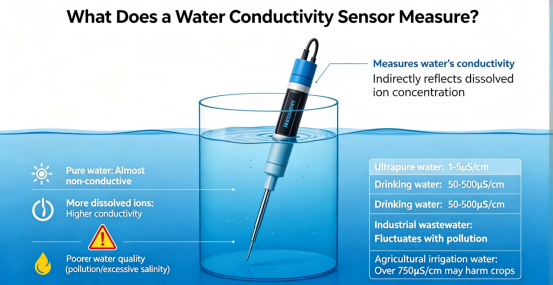
A water conductivity sensor does not directly detect pollutants, but indirectly reflects dissolved ion concentration by measuring water’s conductivity. Pure water is almost non-conductive; more dissolved ions mean higher conductivity and possibly poorer water quality (e.g., pollution or excessive salinity).
Reference ranges: Ultrapure water (1-5μS/cm), drinking water (50-500μS/cm), industrial wastewater (fluctuates with pollution), and agricultural irrigation water (over 750μS/cm may harm crops).
The key difference lies in whether the sensor contacts water directly, with each type suitable for different scenarios.
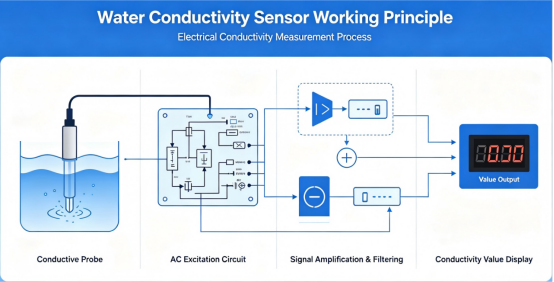
Common and cost-effective, it uses corrosion-resistant electrodes (platinum, graphite) immersed in water. AC voltage is applied to generate current via ion movement, with fast response and high accuracy—ideal for ultrapure water, drinking water and laboratory use.
Two-electrode: Simple, low-cost for basic scenarios; Four-electrode: Anti-polarization, wide range (0.1μS/cm-1000mS/cm) for industrial online monitoring.
No direct water contact, using electromagnetic coils to generate eddy currents in water. It is pollution-resistant and corrosion-resistant, suitable for industrial wastewater, high-turbidity water and strong acids/alkalis, but less accurate for low conductivity and higher cost.
Avoid focusing only on price/range when selecting a water conductivity sensor; focus on these 3 points for accurate selection:
Low conductivity (0.05~2μS/cm): K=0.01cm⁻¹, platinum electrode + temperature compensation;
Regular scenarios (0.1~2000μS/cm): K=0.1/1.0cm⁻¹, cost-effective and accurate;
High conductivity (>10mS/cm): K≥10cm⁻¹, four-electrode/inductive type.
Clean, low-precision: Two-electrode (laboratory sampling, drinking water testing);
Complex, high-precision: Four-electrode/inductive (industrial online monitoring, wastewater treatment);
Material: Platinum (ultrapure water, high temperature), graphite (municipal sewage), stainless steel (industrial cooling water), titanium alloy (seawater, chlorine-containing water).
Conductivity changes with temperature (2%-3% per ℃), so choose sensors with built-in temperature compensation (e.g., Pt1000). Installation: Immersion (laboratory), pipeline (industrial), flow-through (low flow, high precision).
Proper maintenance of a water conductivity sensor ensures accuracy and extends its service life (1-2 years):
Clean every 2-4 weeks (clean water) or 1-2 weeks (polluted water). Use a soft brush + neutral detergent; soak mineral deposits in 5%-10% dilute hydrochloric acid (5-10 mins), rinse with pure water, and avoid hard scrubbing.
Calibrate with standard solutions (100μS/cm, 1000μS/cm) before first use, re-calibrate every 1-2 months or after electrode replacement. Ensure linear error ≤5%.
Install 1m+ away from high-power equipment (anti-electromagnetic interference); avoid heat/sunlight; control water flow (0.5-1m/s); check wiring and waterproof seals monthly.
Higher conductivity ≠ worse pollution (e.g., seawater, mineral water);
Uncalibrated sensors cause data distortion, especially in low-conductivity scenarios;
Inductive type is not suitable for all scenarios (low accuracy for low conductivity, high cost);
Over-cleaning (hard brushes, long acid soaking) damages electrodes.
Water conductivity sensors provide reliable data for water quality monitoring. Grasp "matching principles to scenarios, suitable selection, standardized maintenance" to maximize the value of your water conductivity sensor.
Whether it is laboratory research, industrial quality control, environmental monitoring, or daily water testing, these tips help avoid mistakes. As a professional manufacturer of ERUN-A4Q intelligent water conductivity sensors, ERUN is committed to providing high-quality monitoring equipment for global users, supporting efficient and accurate water quality management.
For model selection or maintenance issues, leave a comment to discuss.


