




Residual chlorine in drinking water is a key indicator of whether a water supply is microbiologically safe from the treatment plant to the consumer’s tap. As one of the most widely used disinfectants in the world, chlorine effectively inactivates bacteria, viruses, and other harmful microorganisms. At the same time, its concentration must be carefully controlled to ensure both public health protection and consumer acceptability. Understanding how much residual chlorine is safe, and how to measure it accurately, is essential for drinking water systems operating under international and national regulations.
Residual chlorine refers to the amount of chlorine that remains in water after the initial disinfection process has been completed and immediate chlorine demand has been satisfied. This remaining disinfectant provides ongoing protection as water moves through storage facilities and distribution pipelines.
Maintaining an adequate residual chlorine level helps prevent secondary contamination caused by pipe leaks, pressure fluctuations, or microbial regrowth. Without sufficient residual chlorine, even well-treated water can become unsafe before it reaches end users. However, excessive chlorine may cause unpleasant taste and odor and increase the risk of forming disinfection by-products, making precise control a critical operational task.
Globally, drinking water safety is guided by the World Health Organization (WHO). According to the Guidelines for Drinking-water Quality, a free residual chlorine concentration of 0.2–0.5 mg/L at the point of delivery is generally sufficient to ensure effective microbial control under normal conditions. From a health perspective, the WHO indicates that chlorine concentrations up to 5.0 mg/L are considered safe for human consumption.
In the United States, residual chlorine limits are regulated under the Safe Drinking Water Act (SDWA) and enforced by the Environmental Protection Agency (EPA). The EPA has established a Maximum Residual Disinfectant Level (MRDL) of 4.0 mg/L for chlorine in drinking water. This regulatory limit balances the need for effective disinfection with long-term health protection.
Organization | Recommended / Allowed Level |
WHO (Guidelines) | 0.2–0.5 mg/L (typical operational range) |
WHO (Health-based limit) | Up to 5.0 mg/L |
U.S. EPA (SDWA MRDL) | 4.0 mg/L |
These values form the scientific and regulatory foundation for chlorine management in modern drinking water systems.
The appropriate residual chlorine concentration is influenced by multiple factors, including water temperature, pH, organic matter content, and the length and condition of the distribution network. Warmer temperatures and longer pipelines often require higher residuals to maintain disinfection effectiveness, while systems with low organic content may operate safely at lower concentrations.
Because residual chlorine can decline as water travels through the system, monitoring at multiple locations is essential to ensure compliance at the point of use.
Setting regulatory limits alone is not enough; accurate and reliable measurement is equally important. Portable testing instruments based on standardized colorimetric methods allow operators to verify residual chlorine levels quickly and confidently in the field.
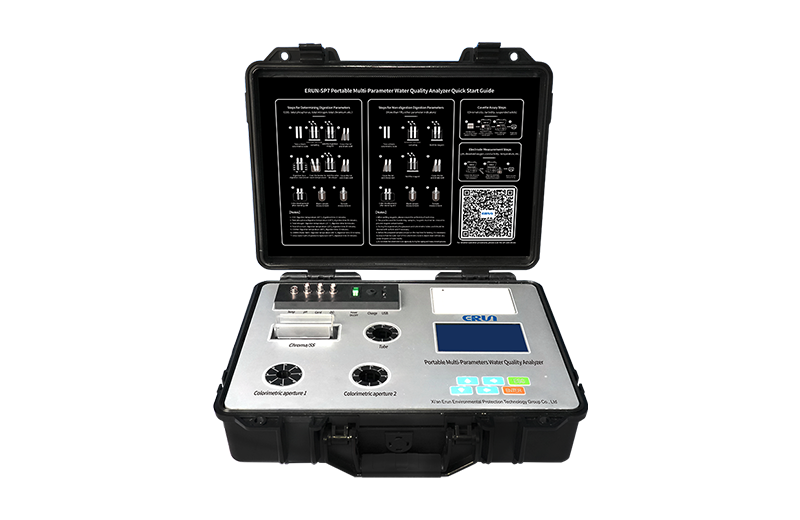
The ERUN-SP7-K6 Portable Residual Chlorine Water Quality Tester from ERUN Environmental Protection is designed to support regulatory compliance across the entire drinking water supply chain. Using an EPA-recognized colorimetric method, the instrument provides precise residual chlorine measurements with an accuracy of ±0.01 mg/L over a wide range of 0.02–10.00 mg/L.
Its high repeatability, strong optical stability, and rugged IP65-rated ABS housing make it suitable for continuous use in municipal water supply systems, as well as in food and beverage, medical, pharmaceutical, and petrochemical industries. Features such as automatic wavelength selection, data storage and printing, and a large LCD interface further improve efficiency during on-site testing.
Maintaining safe residual chlorine in drinking water depends on applying internationally recognized standards and verifying them through accurate measurement. WHO guidelines and the U.S. Safe Drinking Water Act provide clear limits that ensure effective disinfection while safeguarding consumers. When these standards are supported by dependable testing tools such as the ERUN-SP7-K6 Portable Residual Chlorine Water Quality Tester, water professionals gain the confidence to monitor, control, and document chlorine levels throughout the distribution system, helping deliver safe and compliant drinking water every day.


