




Why Heavy Metal Detection in Water Matters More Than Ever
Heavy metal contamination in water is a growing global concern. From drinking water and groundwater to industrial wastewater and surface water, toxic metals such as lead, cadmium, mercury, arsenic, copper, and chromium pose serious risks to human health and the environment.
Both the World Health Organization (WHO) and the US Environmental Protection Agency (EPA) have established strict maximum contaminant levels for heavy metals in drinking water. For example, WHO sets the guideline for cadmium at 3 μg/L, while EPA sets it at 5 μg/L. Yet, many rivers, lakes, and groundwater sources worldwide have been polluted to varying degrees by industrial discharge, mining runoff, agricultural fertilizers, and improper waste disposal.
Regularheavy metal water testing is no longer an option—it is a necessity for water treatment plants, environmental monitoring agencies, industrial facilities, and even private well owners.
To understand why detection is critical, we must first know what we are testing for:
Heavy Metal | Common Sources | Health Effects | WHO Guideline |
|---|---|---|---|
Lead (Pb) | Old plumbing, mining, industrial waste | Neurological damage, kidney issues | 10 μg/L |
Cadmium (Cd) | Fertilizers, landfills, electroplating | Kidney dysfunction, osteoporosis, cancer | 3 μg/L |
Arsenic (As) | Natural deposits, mining, smelting | Skin damage, liver disease, diabetes | 10 μg/L |
Chromium (Cr) | Industrial discharge, leather tanning | Diarrhea, headache, nausea | 50 μg/L |
Copper (Cu) | Corroded pipes, mining | Liver and kidney damage | 2 mg/L |
Mercury (Hg) | Coal burning, industrial waste | Neurological damage | 1 μg/L |
Iron (Fe) | Natural deposits, corroded pipes | Metallic taste, staining | 0.3 mg/L |
These contaminants enter water through both natural sources (rock weathering, geothermal activity) and anthropogenic sources (inadequately treated industrial wastewater, manufacturing discharge, mining operations).
When searching for a water heavy metal detector, you will encounter several detection technologies. Here is a quick overview:
Atomic Absorption Spectroscopy (AAS) – Highly sensitive and accurate, but requires laboratory conditions and skilled operators. Not suitable for field use.
Inductively Coupled Plasma Mass Spectrometry (ICP-MS) – Extremely precise and can detect multiple metals simultaneously, but equipment is expensive and not portable.
Electrochemical Methods (Anodic Stripping Voltammetry) – Good sensitivity and relatively portable, but can be affected by water matrix interference.
Colorimetric Methods – The most practical for on-site and field applications. Uses chemical reagents that react with specific metal ions to produce color changes, measured by a spectrophotometer at specific wavelengths.
Colorimetric detection is widely adopted for portable and field applications because it offers a balance of accuracy, affordability, and ease of use. It does not require specialized training or laboratory infrastructure, making it ideal for environmental monitoring and rapid on-site screening.
The choice between portable and laboratory-based water heavy metal detection depends on your specific application:
Laboratory Testing – Provides the highest accuracy and lowest detection limits. Best for regulatory compliance documentation, detailed chemical analysis, and research purposes. However, it is time-consuming (samples must be collected, shipped, and processed), expensive, and not suitable for real-time decision-making.
Portable Heavy Metal Water Tester – Offers on-site, real-time results within minutes. Ideal for field inspections, emergency response to water pollution incidents, industrial wastewater monitoring, and drinking water quality screening at the point of use. It significantly reduces testing costs and turnaround time.
For most environmental monitoring and industrial applications, a portable multi-parameter water quality analyzer is the most practical and cost-effective solution.
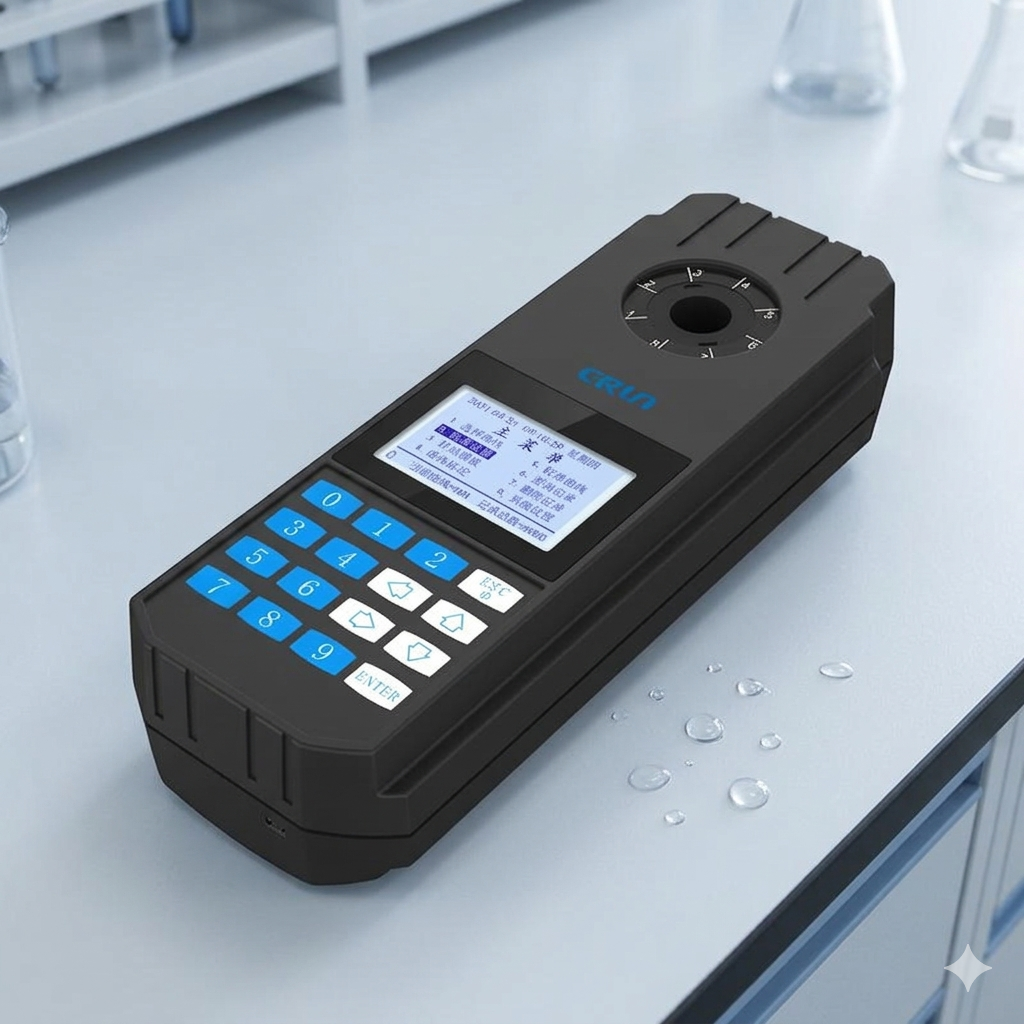
For organizations seeking a reliable, accurate, and easy-to-use solution for heavy metal detection in water, the Erun ERUN-SP6-8 Portable Multi-Parameter Water Quality Analyzer is an ideal choice.
Developed and manufactured by Xi‘an Erun Environmental Protection Technology Co., Ltd., this instrument is designed for on-site and field water quality analysis. It utilizes a cold light source with narrow-band interference optical technology, ensuring stable optical performance and reliable measurements.
Specification | Detail |
|---|---|
Model | ERUN-SP6-8 |
Number of Channels | 8 channels |
Wavelength Options | 420–700 nm (any 8 customizable) |
Wavelength Precision | Central wavelength ±1 nm |
Optical Stability | Absorbance drift <0.002A in 20 min |
Measurement Parameters | 35 parameters (customizable) |
Control Functions | PID automatic temperature control, timing functions |
Portability | Compact, easy to carry, suitable for field use |
The ERUN-SP6-8 can measure multiple heavy metals and water quality parameters, including but not limited to:
Copper (Cu) – corrosion indicator, industrial discharge marker
Iron (Fe) – common in groundwater and corroded pipes
Nickel (Ni) – industrial wastewater contaminant
Hexavalent Chromium (Cr⁶⁺) – highly toxic industrial pollutant
Manganese (Mn) – often found in groundwater
CODMn (Permanganate Index) – organic pollution indicator
Phosphate – nutrient pollution indicator
Nitrite Nitrogen – agricultural runoff marker
Ammonia Nitrogen – sewage and agricultural indicator
✅ Portable and Field-Ready – Designed for easy transport and use in remote locations, industrial sites, and emergency scenarios. No laboratory required.
✅ Multi-Parameter Capability – Tests up to 35 different parameters in a single compact instrument, saving time and equipment costs.
✅ High-Precision Optics – Wavelength drift is minimized through software calibration. The cold light source and narrow-band interference optical system deliver stable and accurate readings.
✅ User-Friendly Operation – Simple interface with PID automatic temperature control and timing functions. Minimal training required.
✅ Customizable – Customers can customize measured parameters based on their specific monitoring needs.
✅ Cost-Effective – A fraction of the cost of laboratory equipment while delivering reliable on-site results.
The Erun ERUN-SP6-8 is suitable for a wide range of applications:
Drinking Water Quality Monitoring – Ensure municipal and private well water meets WHO and EPA standards.
Industrial Wastewater Discharge Control – Monitor heavy metal concentrations before discharge to comply with environmental regulations.
Environmental Protection Agencies – Rapid field screening of surface water, groundwater, and rivers.
Mining and Metallurgical Industries – Detect metal contamination in process water and surrounding water bodies.
Agricultural Runoff Monitoring – Identify contamination from fertilizers and pesticides.
Aquaculture and Fisheries – Maintain optimal water quality for fish and aquatic life.
Emergency Response – Rapid on-site assessment following chemical spills or natural disasters.
Water quality regulations vary by country, but the global trend is toward stricter limits for heavy metals in drinking water and wastewater. Major standards include:
WHO Guidelines for Drinking-water Quality – Widely adopted as the international benchmark.
US EPA National Primary Drinking Water Regulations – Legally enforceable standards for public water systems.
EU Drinking Water Directive – Stringent limits for 20+ heavy metals and other contaminants.
Using a portable water quality analyzer that delivers accurate, reproducible results helps organizations demonstrate regulatory compliance and protect public health. The Erun ERUN-SP6-8 is designed with the precision and stability required for compliance monitoring.
When evaluating water heavy metal detectors, consider the following factors:
Number of Parameters – Does the instrument test for the specific heavy metals relevant to your application?
Detection Range and Accuracy – Are the detection limits low enough for your regulatory requirements?
Portability – Do you need on-site testing or will samples be sent to a lab?
Ease of Use – Can your team operate the instrument without specialized training?
Durability – Is the instrument rugged enough for field conditions?
Cost – What is the total cost of ownership (instrument + reagents + maintenance)?
After-Sales Support – Does the manufacturer provide technical support, calibration services, and replacement parts?
The Erun ERUN-SP6-8 excels in all these areas, making it a trusted choice for environmental professionals worldwide.


