




Choosing the right testing equipment starts with a common question: what is the best water quality tester? For professionals working with drinking water, surface water, or sewage, accurate water quality data is the foundation of safe decision-making. This article explains what defines a good tester, how different types compare, and how modern multi-parameter solutions help users test more efficiently and accurately.
Water testing errors can lead to serious consequences. Inaccurate readings may result in unsafe drinking water, compliance failures, or incorrect treatment decisions. For environmental monitoring and wastewater management, poor testing data can also mean higher costs and operational risks.
Different applications require different tools. Field engineers need fast and flexible testing, while laboratories prioritize stability and precision. Understanding what is the best water quality tester means matching the instrument to real testing scenarios rather than choosing based on price alone.
The “best” tester depends on how and where it is used.
For on-site inspections and emergency checks, portability and multi-parameter capability matter most. For laboratories and routine analysis, consistency, expandability, and controlled testing conditions are more important.
In both cases, users increasingly prefer multi-parameter water quality testers that reduce the need for multiple instruments and deliver complete water profiles in one test.
When evaluating options, several features clearly separate basic tools from professional equipment.
The ability to test multiple indicators—such as pH, conductivity, TDS, dissolved oxygen, and temperature—at once improves efficiency and data reliability. A true water quality analysis equipment solution should support flexible parameter combinations.
Optical methods are ideal for detecting a wide range of chemical parameters, while electrode methods provide high accuracy for core indicators like pH and conductivity. Instruments that combine both technologies offer a major advantage in accuracy and application range.
Testing needs change over time. The best water quality tester should allow parameter expansion instead of forcing users to replace the entire device when requirements grow.

ERUN-SP9 is designed for professionals who need accurate results outside the laboratory.
As a best portable water quality tester solution, it uses an advanced 16-channel optical system capable of detecting more than 60 water quality parameters. By combining optical technology with electrode measurement, it ensures reliable detection of core indicators such as pH, conductivity, TDS, salinity, dissolved oxygen, and water temperature.
Eliminates the need to carry multiple instruments
Supports free parameter combination, adapting to different projects
Delivers fast, accurate results for on-site decision-making
ERUN-SP9 is especially suitable for field testing, environmental monitoring, and situations where rapid response and measurement accuracy are both critical.
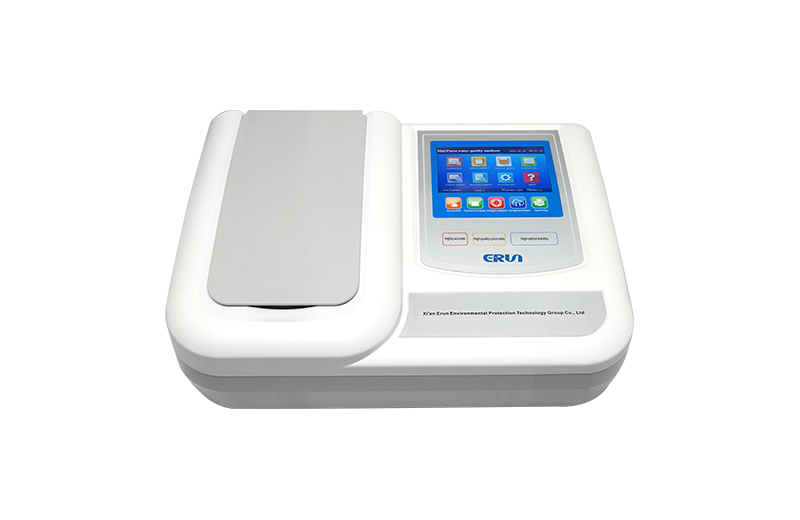
For laboratories and routine analysis, ERUN-ST7 provides a stable and flexible benchtop solution.
As a professional laboratory water quality analyzer, ERUN-ST7 integrates optical and electrode methods to support accurate detection of pH, conductivity, TDS, dissolved oxygen, and temperature. Users can freely configure parameters based on their testing needs, avoiding unnecessary complexity.
Reliable benchtop performance for long-term testing
Suitable for drinking water, surface water, and sewage analysis
Flexible configuration supports changing testing standards
Supports free parameter combination, adapting to different projects
This makes ERUN-ST7 a strong choice for users who need consistent data and standardized testing environments.
To decide what is the best water quality tester for your work, consider:
Testing location: field or laboratory
Number and type of parameters required
Accuracy and repeatability expectations
Long-term upgrade potential
For many users, multi-parameter water quality testers offer better long-term value by reducing equipment redundancy and improving testing efficiency.
There is no one-size-fits-all answer to what is the best water quality tester. The best choice depends on application, environment, and testing goals.
For portable, flexible field testing, ERUN-SP9 provides a powerful multi-parameter solution. For laboratory and routine analysis, ERUN-ST7 offers stability, accuracy, and adaptability. Both instruments focus on solving real customer problems—delivering reliable data, improving efficiency, and supporting confident decision-making in water quality management.


