




Chlorine plays a critical role in keeping water safe across drinking water systems, industrial processes, and environmental applications. However, simply adding chlorine is not enough. Knowing how to test chlorine in water accurately is essential to ensure effective disinfection without causing corrosion, health concerns, or regulatory issues.
Whether you manage municipal water supplies, industrial water treatment systems, or aquaculture operations, reliable chlorine testing helps you maintain water quality, protect equipment, and meet compliance standards.
Chlorine is widely used to eliminate bacteria, viruses, and microorganisms. However, incorrect chlorine levels can quickly become a problem. Low chlorine levels reduce disinfection efficiency, while excessive chlorine may cause taste issues, equipment damage, or environmental harm.
That is why chlorine measurement in water is a routine requirement in drinking water systems, industrial water treatment, power generation, food processing, and environmental monitoring. Accurate testing allows operators to take corrective actions early, reducing long-term risks and operational costs.
When learning how to test chlorine in water, it is important to understand the forms chlorine can take.
Free chlorine refers to chlorine that is immediately available for disinfection. Combined chlorine forms when chlorine reacts with ammonia or organic nitrogen compounds. Total chlorine includes both free and combined chlorine. Each form provides insight into water quality and treatment effectiveness.
Different applications require different testing approaches. Drinking water systems focus on safety and taste, while industrial users prioritize system stability and corrosion prevention.
There are several methods used for chlorine testing method selection, each with its own strengths and limitations.
Test strips are widely used for quick checks. They are simple and inexpensive but often lack precision and consistency, making them unsuitable for professional or regulatory applications.
Reagent-based test kits rely on color comparison. While more accurate than strips, results depend heavily on user experience and environmental conditions.
Digital instruments and portable testers are becoming the preferred solution for professionals. A water chlorine tester provides fast, repeatable results with minimal human error. These devices are especially valuable for field testing, where laboratory access is limited and immediate decisions are required.
Accurate chlorine testing starts with proper sampling. Samples should be collected in clean containers and tested promptly to avoid chlorine loss.
Using a portable water chlorine tester, users can perform on-site measurements without complex preparation. The testing process is fast, results are easy to interpret, and measurements are more consistent than manual methods. This approach significantly reduces testing time and improves reliability, especially in environments where frequent testing is required.
Chlorine testing can be affected by temperature changes, turbidity, and interfering ions. Manual methods may also lead to inconsistent readings due to differences in lighting, operator technique, or reagent handling.
These challenges often result in delayed corrective actions or unnecessary chemical adjustments. Modern digital testing solutions help overcome these issues by providing stable and objective measurements regardless of external conditions.
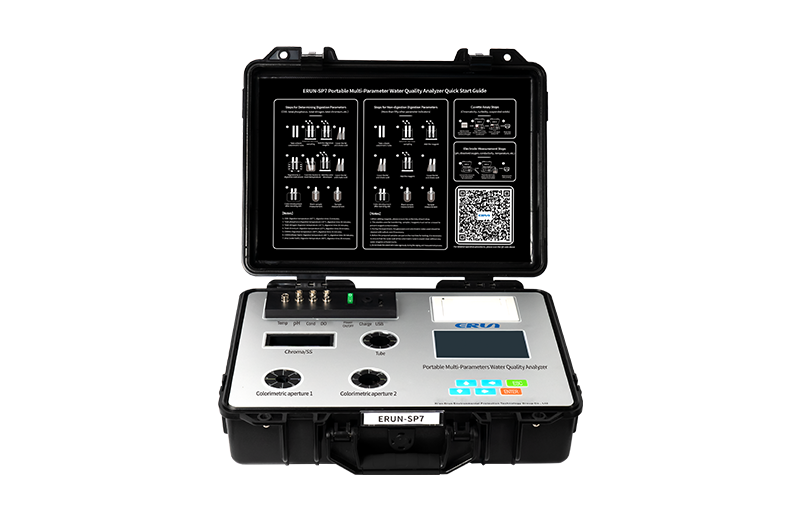
For professionals seeking a reliable solution, the Portable Water Chloride Tester ERUN-SP7-C4 is designed to simplify and improve water quality management.
This instrument enables fast and precise determination of chloride ion concentration, supporting accurate control of chlorine-related parameters in water systems. It is especially suitable for municipal water supply, environmental monitoring, food and beverage production, thermal power generation, aquaculture, and water treatment industries.
By enabling efficient on-site testing, ERUN-SP7-C4 helps users reduce laboratory dependence, respond quickly to water quality changes, and improve operational efficiency. Its portability and ease of use make it ideal for both routine inspections and troubleshooting scenarios, ensuring reliable results wherever testing is needed.
Understanding how to test chlorine in water is essential for maintaining water safety and system performance. From basic methods to advanced digital tools, accurate chlorine testing ensures effective disinfection and operational stability.
Professional solutions like ERUN-SP7-C4 support reliable, on-site chlorine monitoring, helping users achieve better water quality control with confidence and efficiency.


