




Boron contamination in water is a global concern, covering drinking water safety, agricultural irrigation, and industrial wastewater discharge. This guide covers boron basics, hazards, global standards, detection methods, equipment, and the cost-effective ERUN-80-B3 Portable Boron Detector.

Boron is a naturally occurring metalloid found in oceans, soils, and rocks. It enters water via natural processes (rock weathering, volcanic activity) and anthropogenic sources (municipal wastewater, industrial discharge, pesticide use). It is an essential plant micronutrient, but excess concentrations threaten environmental and human health.
Human health: Excess intake damages the stomach, liver, kidneys, and brain, and may be fatal.
Plant health: Boron toxicity inhibits growth, causes leaf tip burn and edge drying, and accumulates in soil to harm long-term crop health.
Key monitoring areas: Regions with geothermal activity, seawater intrusion, or industrial discharge require strict water quality monitoring.
Standard | Limit |
WHO (4th Edition) | 2.4 mg/L |
EU | 1.0 mg/L |
Health Canada (MAC) | 5 mg/L |
US EPA (long-term health advisory) | 6.0 mg/L |
China (GB 5749) | 0.5 mg/L |
Note: Limits for industrial wastewater and agricultural irrigation vary by sector.
ICP-MS: Ultra-high sensitivity for trace analysis, but requires expensive lab equipment and skilled staff, unsuitable for field use.
Azomethine-H: Colorimetric method with good accuracy, widely used in portable analyzers and test kits.
Curcumin Method: ASTM D3082 standard, applicable for 0.1–1.0 mg/L boron.
Carmine & Titration: Alternative methods with different sensitivity and application scopes.
Portable photometry is preferred for field testing of surface water and wastewater.
Online Analyzers: Real-time continuous monitoring for desalination plants, water treatment facilities; brands include SUEZ, Hach.
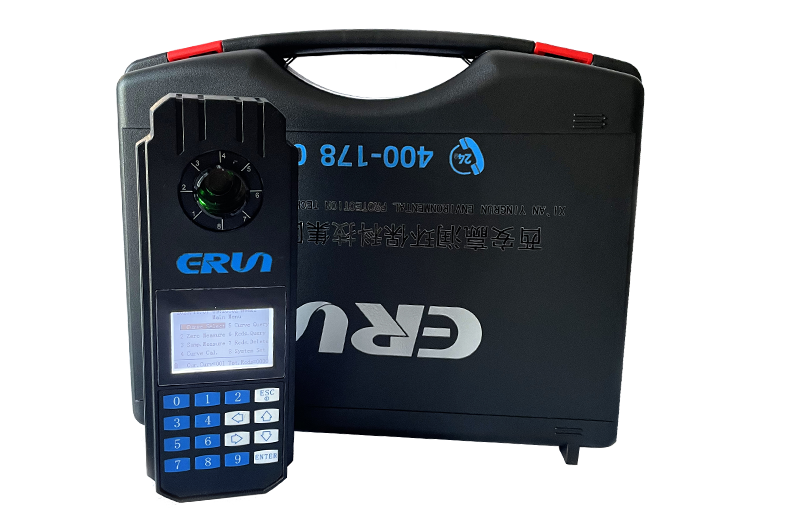
Portable Analyzers: Field-deployable for drinking water, irrigation water, wastewater, and environmental monitoring.
Chemical Test Kits: Low-cost, disposable, for basic screening; low accuracy and no data logging.
Developed by Xi‘an Erun Environmental Protection Co., Ltd., this device balances accuracy, portability, and affordability.
Parameter | Value |
Measuring range | 0.10–2.00 mg/L |
Indication error | ≤±5% |
Repeatability | ≤3% |
Optical stability | Drift <0.002A/20min |
Dimensions | 80×230×55 mm |
Weight | <1 kg |
Data storage | 199 time-stamped records |
Imported long-life cold light source (100,000 hours) + narrow-band filter for strong stability and anti-interference.
IP65 ABS housing: waterproof, dustproof, corrosion-resistant.
Power-off data protection; stores 10 standard curves and 199 measurements.
Drinking water, surface water, groundwater, municipal sewage, industrial wastewater, agricultural irrigation water, environmental samples.
Higher precision than disposable kits with quantitative data and electronic storage.
Cost-effective vs. Hach, Hanna, and other domestic brands; reliable performance and full after-sales support.
14 years of manufacturing experience in water quality instruments.
Municipal water utilities, agriculture, industrial facilities, environmental consulting, research institutions.
Best testing method: Azomethine-H colorimetry; portable analyzers (e.g., ERUN-80-B3) are optimal for field use.
Purchase: Official website: https://www.erunwas.com/products-detail/id-122.html; Email: sales@erunwas.com.
Normal boron range: 0.1–1.0 mg/L in natural drinking water; >2.4 mg/L exceeds WHO guidelines.
Price: Professional portable analyzers: ~$500–2,000 USD; ERUN-80-B3 offers superior value.
The global boron analyzer market was valued at USD 2.7 billion in 2025, projected to reach USD 4.4 billion by 2035 (CAGR 5.0%). Driven by stricter regulations, rising water quality awareness, and demand from desalination, microelectronics, and semiconductor ultrapure water sectors.
Boron monitoring is critical for global water quality management. The ERUN-80-B3 Portable Boron Detector delivers lab-grade accuracy, field portability, broad measurement range, stable optics, large data storage, and IP65 durability at a cost-effective price, suitable for all-scale organizations.
For details and orders: https://www.erunwas.com/products-detail/id-122.html


